Why a Transfer Adds More Than Minutes
A transfer adds more than minutes. Learn to map each handover, spot its pinch points and decide what information or fallback will make it manageable.
A transfer adds more than minutes because it is a handover: you leave one service, find the next, and take responsibility for getting aboard. On an urban commute, knowing what each handover requires can help you prepare for the parts of a journey that a route map cannot show.
The useful question is not how transfers compare with a direct ride. It is what happens at the moment one leg ends: where to go, what information to check, and what to do if the plan changes. Treating that moment as its own part of the journey makes it easier to handle calmly.
Map the handover
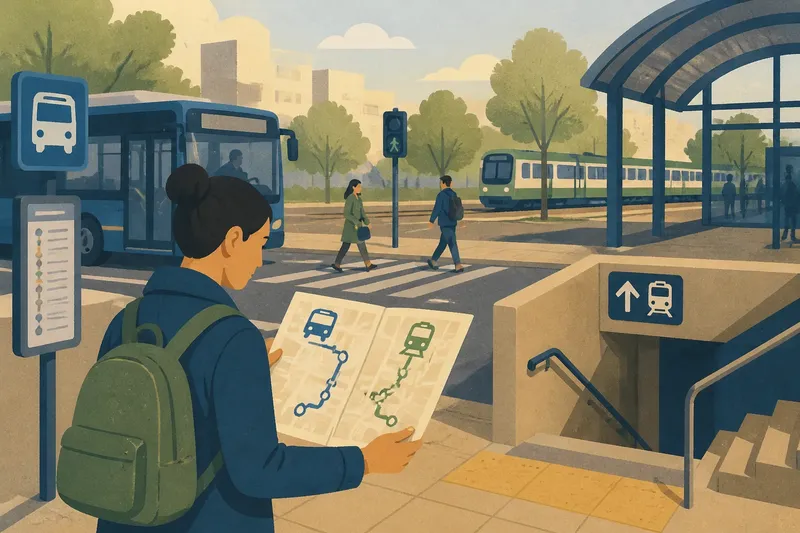
Start with the physical sequence rather than the timetable. Note the stop or platform where you leave, the path to the next boarding point, and the sign or display that confirms you are in the right place. A transfer inside a station may involve a corridor or stairs; one between street stops may require crossing a road and identifying the correct side.
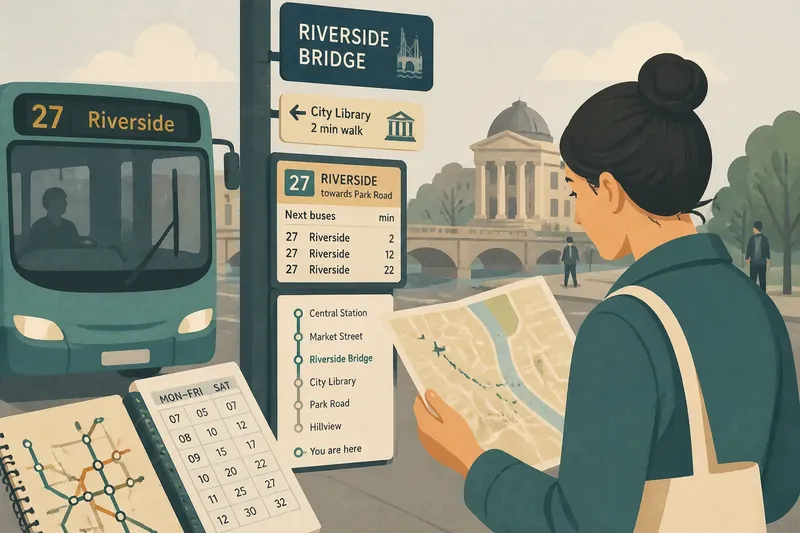
Use the operator’s route map and current service information to check names and locations. In a station, follow the fixed signs as well as any app directions: phone instructions may describe the destination, while signs tell you what is physically in front of you. If the next service departs from a bay or platform with similar names nearby, note the exact wording before setting off.
Notice the pinch points
A transfer’s difficult moment is often not the walk itself but the point where information is missing. You might reach a station exit and find several street stops, or arrive at a platform where displays show multiple services. Identify that pinch point in advance and decide what would resolve it: a stop name, a route number, a direction of travel, or an operator notice.
Conditions can change what the handover asks of you. A busy passage may make a sign harder to see; carrying a bag may make stairs awkward; a street crossing may be easier to find in daylight than after dark. These are observations to make about your own route, not reasons to assume every transfer will be difficult.
Prepare a fallback
A fallback is a simple next action, not a second full commute to memorise. Check whether the operator lists another departure, whether a nearby stop serves the same direction, or whether staff or a help point can clarify a platform change. Keep the relevant stop name or route number in your phone notes so you can look it up without reconstructing the whole journey.
- Stop name: If the next stop has a clear, matching name on the sign and in the app, follow it; if names differ, pause and confirm with the operator’s current information.
- Route number: If the number on the display matches your plan, continue to that boarding point; if it does not, check the destination shown before boarding.
- Walking path: If signs lead continuously to the next platform or stop, follow them; if the path breaks at an exit, check the map or ask staff before choosing a street direction.
- Service notice: If the operator reports a platform or stop change, use the updated location; if no current notice is available, check the station display or ask an attendant.
- Connection time: If you can walk and orient yourself without rushing, proceed with the planned change; if the connection feels too tight, identify the next listed service before leaving the first leg.
- Accessibility route: If the marked lift or step-free path is operating, follow that route; if it is closed or unclear, ask staff or check the operator’s accessibility information for another way through.
- Help point: If a help point or staffed desk is visible, use it when directions conflict; if neither is available, consult the operator’s app or service page before committing to an unfamiliar route.
Record what happens
After a commute, make a brief note of one observable detail: the sign that helped, the point where you hesitated, or the notice that changed your route. Avoid turning the note into a judgement about the whole journey. A single delay may be unusual; a repeatedly unclear exit is a feature worth preparing for.
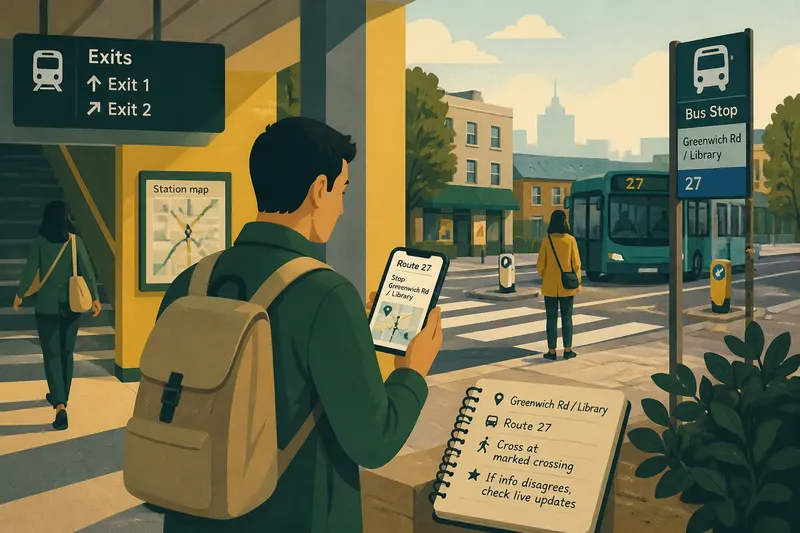
Say you take a hypothetical train to a station and then walk to a street-level bus stop. Your starting inputs are the station name, the bus route number and an app map showing a stop outside the main exit. First, you check the station signs and find that they direct you to two exits but do not name the bus stop. Next, you compare the stop name in the app with the street sign and see that the correct stop is across the road. You then note the crossing and the exact stop name in your phone. The resulting decision is to follow the signed exit, cross at the marked crossing and verify the route number at the stop; if the sign or app disagrees on the day, check the operator’s live information before boarding. The tradeoff is a little preparation in exchange for fewer unresolved choices at the handover.
Questions about transfers?
Does a walk between stops count as a transfer?
Yes, if you leave one service and need to find another boarding point. Record where the walk begins and ends, especially if it crosses a road or uses a different station entrance.
What should I check before changing platforms?
Confirm the platform or bay, the service destination and any current operator notice. If the display and app disagree, use the latest station information or ask staff rather than guessing.
What can I do if a connection is disrupted?
Check the operator’s service update and identify the next available departure or an advised alternative. If the information is unclear, ask staff or use the operator’s help channel before setting off in a new direction.
How can I remember an unfamiliar interchange?
Save the station name, the next stop name and one useful direction in a phone note. After travelling, update the note with the sign or landmark that actually helped, so the transfer is easier to recognise next time.
Keep useful notes
Good transfer notes stay focused on the handover: the exact boarding point, the information that confirms it, and the fallback if that information changes. Check them against current operator notices before travelling, since station layouts and service arrangements can change.
For a transfer, the practical value of preparation is knowing what to look for at the boundary between services. Keep the route name, next boarding point and one fallback together, and you will have a clearer next action when the journey asks you to change course.