The Departure-Time Myth: Earlier Is Not Always Calmer
Departure time planning works better when you choose a useful arrival window and account for known delays, rather than adding an unexamined buffer.

Departure time planning can make a city journey more tense when “leave much earlier” is the only rule. Imagine Mara, an invented commuter travelling from a residential street to a shared office near the centre: she has been arriving so early that she waits outside a locked meeting room, yet still feels rushed whenever a bus runs late. Her problem is not a lack of spare time. It is that her spare time has no purpose or limits.
Her situation offers a useful way to think about timing. Instead of treating early departure as a universal remedy, Mara can choose an arrival window that fits the first thing she must do, then account for uncertainties she actually encounters. The result is not a promise of a perfectly calm trip. It is a departure plan she can understand and revise.
The arrival has a purpose
Mara’s work begins at a fixed time, but she does not need to be at her desk the moment she reaches the building. She wants time to hang up her coat, refill her water bottle and settle before a meeting. That makes “arrive early” too vague to guide her. A better target is an arrival window: late enough that she is not spending a long stretch waiting, but early enough for those ordinary tasks.
She starts by separating three times that had blurred together:
- Ready time: when she needs to be prepared for the meeting.
- Building arrival: when she expects to reach the entrance.
- Journey start: when she leaves home, including the walk to the stop.
Working backwards from readiness gives her a practical arrival window without turning every minute into a countdown. If the meeting starts with a quiet check-in rather than an immediate presentation, she can allow a modest settling interval. If she has to collect a visitor pass or carry equipment, the window needs to account for that instead.
This distinction matters because an early arrival is not automatically useful. An hour spent waiting in a draughty lobby may drain attention and make the day feel longer. A short, intentional pause to get ready can be more valuable than an arbitrary stretch of empty time.
Uncertainty has a shape
Mara then looks at what actually makes her arrival vary. Her route has a walk to a bus stop, a ride across town and a final walk through a busy entrance. She is not trying to analyse every possible disruption. She is identifying the few parts where the journey’s timing tends to be less predictable.
For her, the bus can bunch up during the school run, while the pavement outside the office becomes crowded just before the meeting hour. The walk from home is steady, and the final street is usually clear. Those distinctions matter: adding a large buffer to every part of the journey treats a predictable walk as if it carried the same uncertainty as a crowded road.
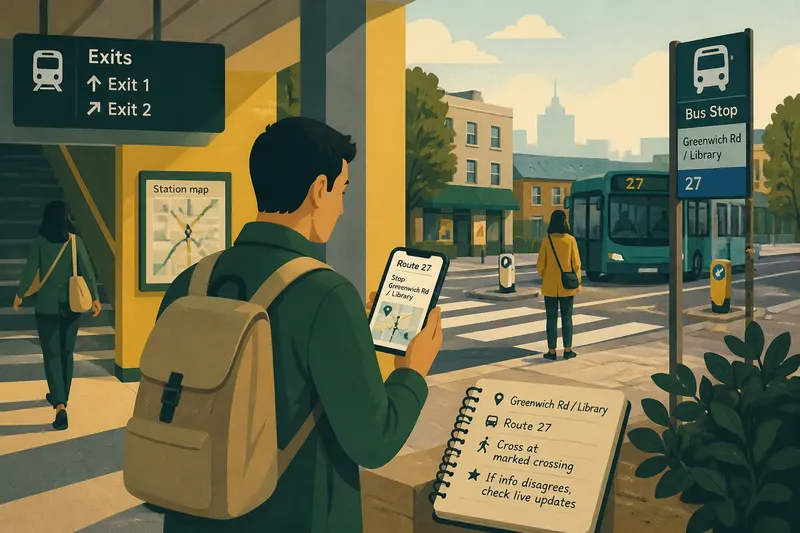
She checks the transport operator’s app for the service pattern and compares it with the route information at the stop. She also notes the days on which the crowded period is most likely. This is not a search for certainty. It is a way to make the plan reflect known conditions rather than vague dread. For a different service, local disruption notices or the printed timetable may be the more useful source.
The practical question becomes: which uncertainty could make her miss the useful arrival window, and what response is proportionate? If the bus is delayed, she may take the next service and send a brief message. If a disruption notice appears before she leaves, she can choose an alternative route. She does not need to build time for every imaginable failure into every ordinary morning.
Buffer without drift
A buffer is helpful when it has a reason. It might cover a connection that is frequently tight, an entrance that can take time to reach, or the possibility of a service delay at a known busy period. It becomes less useful when its size is chosen simply because “more must be safer”. That kind of buffer can move the real cost from a missed meeting to a daily wait that is tiring in its own right.
Mara’s first adjustment is to pick a departure that normally puts her inside the arrival window, then add a small allowance for the bus period she has identified. She does not add the same allowance to the walk, the ride and the final approach. If a particular morning includes a presentation or an unfamiliar venue, she can choose an earlier service for that occasion rather than making every commute fit the most demanding day.
She also decides what she will do with spare time. If she arrives near the early edge of the window, she can stop at a nearby café, review her notes or take a short walk before going inside. That makes an early arrival a deliberate choice instead of a period of helpless waiting. On mornings when there is no useful place to pause, she has a stronger reason to avoid setting her target unnecessarily early.
There is a trade-off: a leaner plan leaves less room for surprises. The point is not to remove all uncertainty but to decide which risks are worth accommodating. A missed appointment may call for a wider buffer than an ordinary workday. A route with infrequent services may need a different plan from one with frequent buses. The right margin follows the consequences and the conditions, not a general rule about leaving as early as possible.
A plan that can change
Mara gives the revised plan a short trial as an invented exercise, not as a claim that one timetable will suit everyone. She writes down the intended arrival window, the bus she plans to take and the reason for her allowance. After each commute, she notes only what would change the plan: a delay that affected arrival, an unexpected queue at the entrance, or a wait that felt needlessly long.
Suppose the bus is repeatedly held up on one weekday. The useful adjustment is to take an earlier bus on that day, not necessarily to leave earlier every day. If the bus arrives on time but the office door is not open, changing the departure will not solve the real problem; she may need to clarify when the building can be entered. If she reaches the office early and still feels unsettled, she can consider whether the waiting place, rather than the journey margin, is the source of discomfort.
This kind of review keeps the plan tied to observable events. It also prevents one unusual morning from becoming a permanent rule. A disruption can justify a temporary change; a recurring pattern can justify a lasting one. Mara can keep a simple note in her phone rather than attempting to reconstruct every trip from memory.
Questions about departure time?
How much time should I leave before work?
Start with when you need to be ready, then allow for the walk, the expected service and any known arrival tasks. Choose an arrival window that fits the day instead of copying a fixed margin from someone else’s commute.
Should I always take an earlier bus?
No: take an earlier service when a specific uncertainty or consequence makes it useful. If the service is dependable for your journey and an early arrival only creates a long wait, a later departure may suit the ordinary day better.
What if my journey time changes each day?
Separate the predictable parts from the variable ones, such as a crowded approach or a service that bunches at a particular time. Adjust for the pattern you can observe, and keep a different option for disruption rather than padding every journey for every possibility.
How do I know whether my buffer is too large?
If you often arrive well before you can usefully settle, and the extra time is not protecting against a clear risk, the margin may be larger than your needs. A short record of actual delays and waiting can help you make a measured adjustment.
Calm comes from clarity
Mara’s revised departure does not make the bus more predictable or remove the chance of a disruption. It gives her a clear target, a reason for the margin she keeps and a response for the uncertainty she has identified. On routine mornings, she can avoid an unnecessarily long wait; on a more demanding day, she can choose a different service for a specific reason.
That is the useful correction to the departure-time myth: earlier is not always calmer. Departure time planning is most useful when it connects a real arrival need to the parts of the journey that can vary. If the journey changes, adjust the part that changed. The small act of naming why you are leaving early can make the decision calmer before you even reach the stop.