How to Make a New Commute Route Easier to Follow
Learn a new commute route with concise stop, direction and fallback notes, so you can follow the journey and make a clear choice when services change.
A useful new commute route note names the stop, service direction and destination cue that tell you what to do next. Keep it focused on the points where you must choose, rather than trying to record every part of the journey.
Build a route note
Before setting off, write the route in order: where you board, the service and direction, where you leave it, and the destination entrance or street you need. Use the names shown on signs, maps or stop displays. A phone note is enough, provided you can scan it without scrolling through a travel diary.
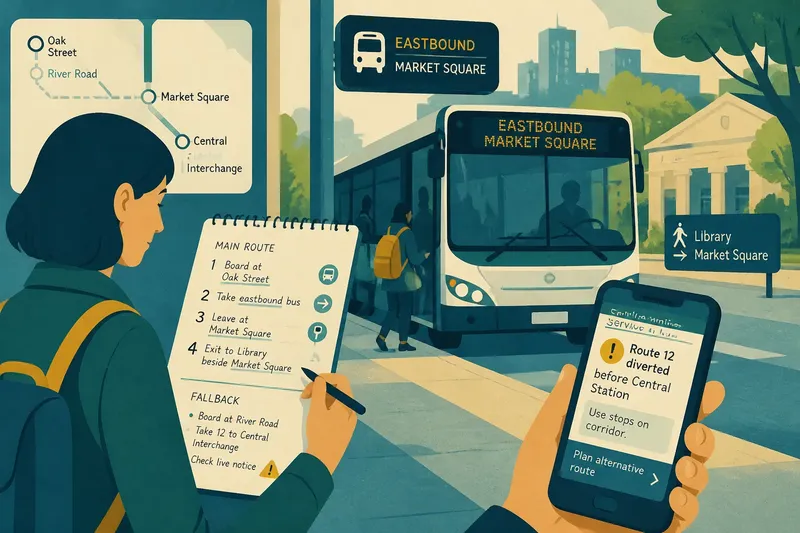
Separate actions from uncertainties. For example: “Board at Oak Street; take the eastbound bus; leave at Market Square.” Add “check which exit” beside any unresolved choice. That makes the note useful in motion and shows what still needs attention.
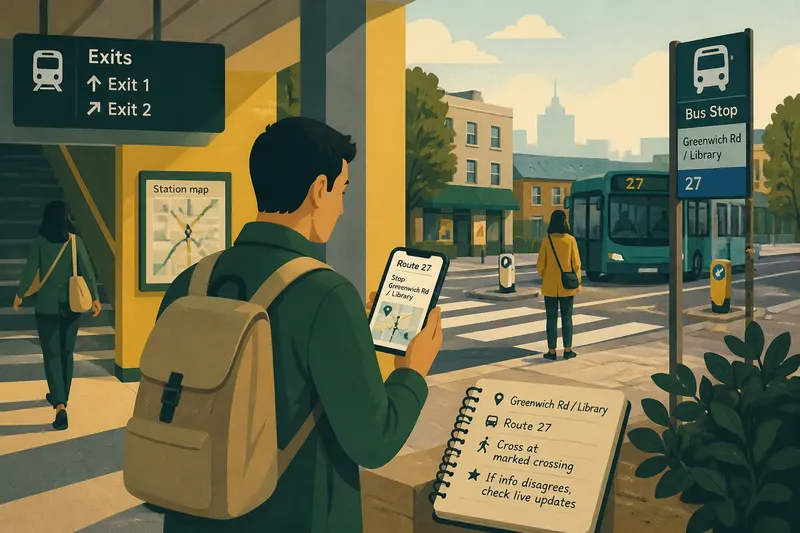
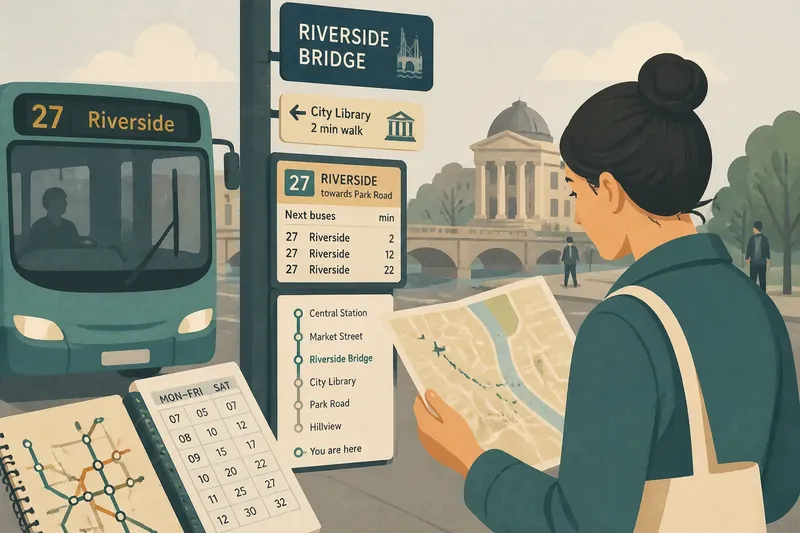
During the journey, record the cue that confirms each decision. It might be a destination on the bus display, a station name announced over the speakers or a street name at the stop. If the name on the map differs from the one announced, keep both; the difference can help you recognise the stop.
Keep the route focused
A route note is not a full map. Include information that changes your next action: which service to board, where to get off, which exit to take or which street to follow. Leave out passing landmarks unless they help distinguish one stop or entrance from another.
Say you are travelling from Oak Street to a library beside Market Square, and your note says only “bus to town”. On the first journey, you see two buses with similar destinations. You add the displayed direction, “eastbound”, and the stop name “Market Square”; next time, those two cues let you identify the bus and where to leave it. The trade-off is a slightly longer note in exchange for a clearer boarding and stopping decision.
Plan a usable fallback
A fallback should state where to board, what service or connection to take, and the familiar place it reaches. Avoid alternatives that end at an unfamiliar location without a clear onward option. Check the operator’s current notices or journey app before relying on a route that may be affected by a diversion.
Imagine your usual bus is diverted before reaching the station. Your note lists a second stop on the same corridor and a service from there to a familiar interchange. You check the live notice, see that the second service is still running, and choose that stop; if the notice also shows a diversion there, you use the app to find another route to the interchange instead. The decision depends on a current, observable service notice, not on an old assumption.
Keep the fallback visibly separate from the main route. If it depends on a different fare, accessible entrance or operator rule, check the relevant operator information before travelling. Where you cannot confirm that the option suits your needs, ask staff or choose a route whose details you can verify.
Check route details?
Do I need to memorise the route?
No. Keep the note available and learn the cues that help you make decisions, such as the service direction or stop name. Familiarity can build without remembering every turn.
How much should I write?
Record the boarding point, service, destination stop and any choice that is easy to get wrong. If the note is awkward to scan, remove details that do not change what you do next.
What belongs in a fallback?
Include a boarding point, a service or connection, and a recognisable place where it ends. Check current notices before using it, since changes can make an alternative unsuitable.
When should I change the route?
Change it when a specific part repeatedly leaves you uncertain or prevents you reaching the destination. First identify that point, then compare alternatives for the feature that matters, such as a clearer stop name or a more legible entrance.
Review the route note
After a journey, update only the detail that proved unclear. A short review can turn a vague memory into a useful cue for next time:
- Boarding display: If the route number or destination is clear, keep it in the note; if two services look similar, add the displayed direction or destination, and use the operator app to check the correct service.
- Stop name: If the announced and mapped names match, keep the single name; if they differ, record both, and check the operator map if neither identifies the stop clearly.
- Exit or street: If the exit leads towards the destination, retain that cue; if it leads away or leaves you uncertain, check the station map and replace the exit instruction with a verified street or landmark.
- Service notice: If the main service is running normally, follow the main route; if a notice shows a diversion or closure, check a current journey app or ask staff before choosing the fallback.
- Fallback endpoint: If the alternative reaches a place you recognise with a clear onward connection, keep it; if not, choose another option that reaches a familiar interchange and confirm how to continue.
- Note length: If you can scan the instruction at the point of choice, leave it as it is; if it is hard to scan, remove background details while keeping the service, stop and decision cue.
For a new commute route, revise the note when a sign, stop name or service changes, or when a particular instruction repeatedly fails to help. If the route itself is sound but one junction remains confusing, clarify that junction rather than replacing the whole journey. A precise note can make the next decision easier without pretending that every disruption is predictable.